

by Lea Amodio
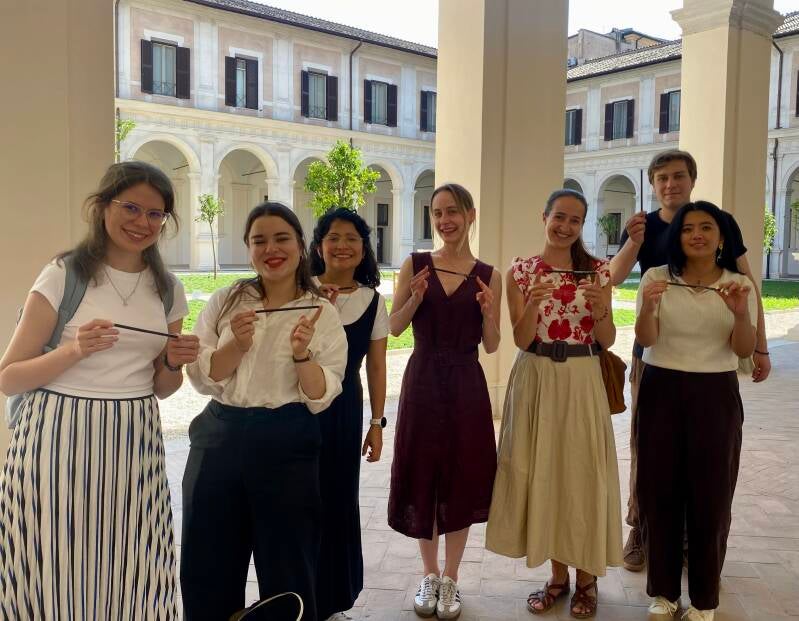
Some students from the cast of "The Jeweller's Shop" by Andrzej Jawień—a pseudonym of Karol Wojtyła—in the courtyard of the Pontifical University of Saint Thomas Aquinas (Angelicum) in Rome.
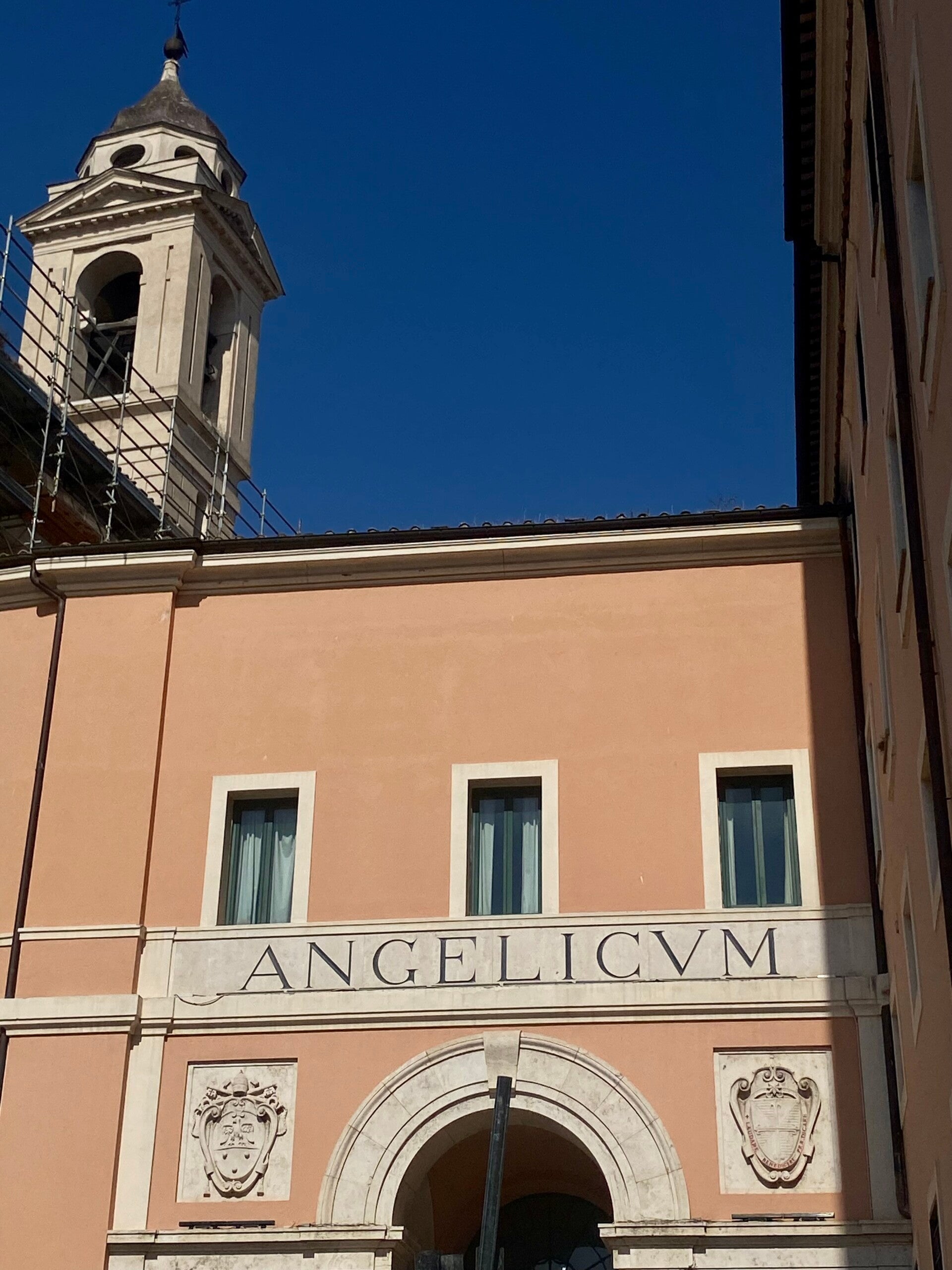
Angelicum, Rome.
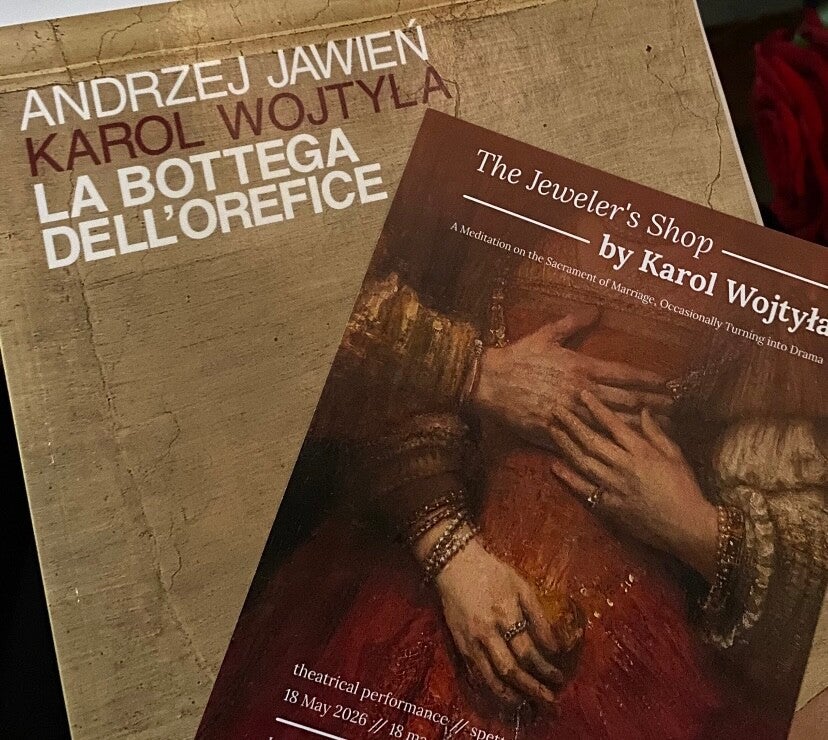
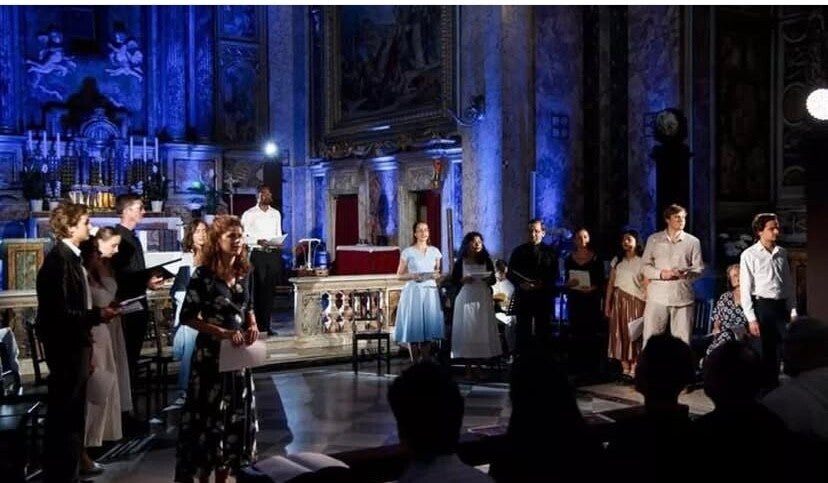
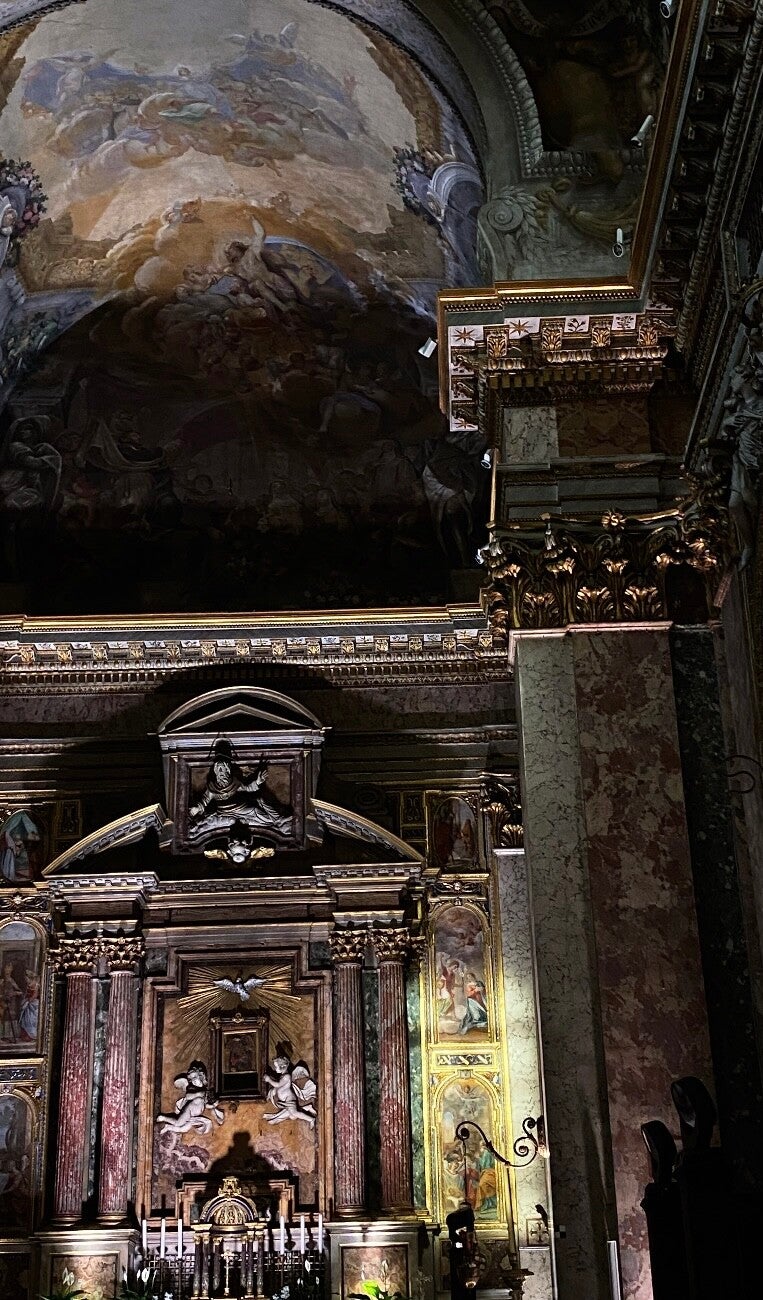
On May 19, 2026, in the Church of Saints Domenico and Sisto at the Angelicum - Pontifical University of St. Thomas Aquinas in Rome, the JPII Studies project staged a single performance of Karol Wojtyła's "The Jeweller's Shop".
The production followed the form of "rhapsodic theatre", the style of acting envisioned by Wojtyła himself: not realistic mimicry, but the Word made action, with light and sound that help the audience enter into the mystery.
In this work it is the words that "make the scene"; no particular objects or sets are needed. Rhapsodic theatre was born out of necessity but then becomes necessary. It removes spectacle in order to put the Word, the body, and the silence of the actors at the center. In this way it enhances what is essential: the interior life of the characters, the weight of a choice, the truth of a relationship. The audience is not asked to watch a realistic imitation, but to enter into a meditation. Light and sound do not decorate, they accompany the Word so that it can reach the heart.
Rhapsodic Theatre, infact, was born in Kraków, Poland in 1941, in the middle of the Second World War, as a form of clandestine cultural resistance against the Nazi occupation. It was founded by the director and theorist Mieczysław Kotlarczyk together with a group of young students, including the future pope Karol Wojtyła. Because of the occupation and the risk of being discovered, it was often impossible to move large sets, furniture, or elaborate costumes. Everything had to be essential, portable, and easy to hide. Performances were held in private apartments, basements, and other non-theatrical spaces.
The jeweller's shop becomes a symbolic place where human love is shaped, like gold. To meditate on this work today means to remember that love is not consumption. It is a continuous choice, a self-gift that seeks eternity. The performance insists on two convictions that we need now: love never dies, and there is always hope. Even in crisis, even in loss, the bond can be worked on and made precious again.
What strikes most deeply in the story is its humanity. Wojtyła enters into the daily struggles of couples, into the experience of falling in love, into the weariness of time, into the pain of widowhood, and also into the encounter with the Bridegroom and His healing power. The three acts show love at the beginning, in maturity, and in memory. At each stage the same question returns: can this love last? The answer given is not naive optimism, but faith: a love open to the transcendent can endure.
Faith, Culture and Beauty
Wojtyła writes that love is the "fourth time", after past, present and future. In this sense, the relationship between Faith and Culture finds its most concrete expression in human works. Art, literature and theatre become places where an intrinsic Love is reflected. They do not limit themselves to representing life; they reveal its deepest meaning.
Throughout "The Jeweller's Shop" this bond is visible. The transcendent does not cancel the human, it fulfils it. Beauty, in the verse and in the gesture, touches the audience and almost wounds it, marks it. For this reason today it is necessary to reflect together on Faith and Culture. When they dialogue, they help us to understand that freedom is not the absence of bonds, but the capacity to choose them, and that truth is not imposed, but discovered through beauty. Joseph Ratzinger - Benedict XVI was also a theologian of love, clarifying a word that is so often abused. Already as a young man he wrote poetry and even Greek hexameters. He saw beauty - in verse, in art and especially in music - as a privileged path to encountering God. His texts on the Sacrament of Marriage and on the nature of love enter into dialogue with Wojtyła's drama. Both insist on the fact that love is not a mere feeling. It is truth, responsibility and gift. It is the place where the human and the divine meet. Today literature and cinema are increasingly rarely inspired by Christianity. Yet there are still works from the recent past and the present that show how faith can illuminate human experience without moralising it. "The Jeweller's Shop" belongs to this line. It does not preach. It shows. And in showing, it invites.
What is JPII Studies
JPII Studies is an academic and cultural program at the Angelicum dedicated to the thought and magisterium of St. John Paul II. Through lectures, seminars, and artistic projects, students explore Wojtyła's philosophical and theatrical works to grasp their relevance and connection to the great questions facing people today: love, freedom, vocation, and marriage.
"The Jeweller's Shop" fits perfectly into this mission: the author himself defined it as "a meditation on the sacrament of marriage that at times becomes drama".
The plot
The play follows three couples at different stages of life: newlyweds Teresa and Andrew, a mature couple Anna and Stephen, and the widow Teresa who speaks with the memory of her husband.
Across three acts, Wojtyła presents a jeweller's shop as a symbolic place where love is "worked," tested, and purified. The Jeweller himself is a figure of God who shapes, tries, and makes human love precious.
Central themes are fidelity, crisis, hope, and the transcendent dimension of love.
Key passages that recur throughout the work are the encounter with the Bridegroom and his healing power, and the conviction that love never dies and that there is always hope.
Why talk about it today
In a time marked by "disposable" relationships, provisional bonds, and the fear of saying "forever," The Jeweller's Shop challenges young people with great force. Wojtyła does not propose a fairy-tale love, but a love that must be worked on, that goes through trials and crises, and that can endure precisely because of that.
It is a reflection we need today: when everything seems replaceable, the play reminds us that true love demands choice, fidelity, and self-gift. And that it is in this very choice that its beauty is revealed.
After the performance, we spoke with several students from the Angelicum cast. Their voices, each with different sensitivities and backgrounds, tell a single shared experience.
INTERVIEW WITH THE STUDENTS
1) How did you prepare for the show? What struck you most about the preparatory lessons?
One student confides: "Our preparation included 3 weeks of daily rehearsals and seminars during which we worked on the text of The Jeweller's Shop. It was not an ordinary theatre project, where the director assigns roles and tells you how to play them."
Another student reflects: "We immersed ourselves deeply in Karol Wojtyła's work: we read it together, trying to understand its meaning and structure, and sharing our personal experience of this meditation, because this piece is 'a meditation on the sacrament of marriage that occasionally becomes drama.'"
A third cast member recalls: "I had read The Jeweller's Shop many years ago. Reading it again as a group was a very precious and moving experience. Jarek Kilian encouraged the students to share their thoughts and even their objections about the situations and characters."
And finally: "What struck me most was the way the professor was able to draw on each person's different talents. Our director called this time a 'retreat,' and I think that's exactly what it became for me."
2) Which part of the text of The Jeweller's Shop struck you the most?
A psychology student observes: "From the very beginning, what struck me most were the monologues of the female characters, which resonated deeply with my own life experience. I was amazed by the depth with which Karol Wojtyła enters into the human experience of daily struggles, but also simply into the experience of falling in love."
Another student points out: "The encounter with the Bridegroom and its healing power" as the central moment.
Finally, a third testimony states: "For me, the most important takeaways are that love never dies and that there is always hope. The way he puts it into words is still relevant today."
3) Which character did you play? What struck you about your character?
One student shares: "I played Anna in the second act — her visions, her meditations, and the encounter with Adam. To be honest, I hadn't really understood this part until I acted it. I saw the dreamlike dimension of this act, a kind of out-of-body experience that was nonetheless deeply embodied in her senses. This shows the holistic perspective with which Karol Wojtyła saw human existence: it cannot be divided, it must be taken as a whole."
Another cast member adds: "I played Teresa in Act III. What struck me was that she continued to speak with her husband who had been dead for a long time, and that she saw the beauty of love, and that it never dies... and that it is worth risking everything for."
4) What do you think this work can convey to young people today?
One student states: "Love — the presence of the beloved — is a call for everyone. Yet God wants to give it the dimension of eternity. Human love is a gift to live the mystery of God."
Another voice comments: "I think the play is still relevant today precisely because we live in a time of disposable relationships. Karol Wojtyła had an incredible gift for reaching the heart of human experience and for saying that love is not consumption, it is choice."
And a third student concludes: "The transcendent nature of hope and love: that there is a higher order to each, which can sustain us through life. Today we need to be reminded of that."
5) Why do you think vocations to marriage have declined today?
One student points out: "People are afraid to give themselves. They are extremely afraid of losing their freedom..."
A female student explains: "I think I can see many of my friends scared by how many things in marriage can go wrong — maybe from the example of their parents, friends, family, the media... We live in a time when it's easier to change than to repair. We lack examples that show us we can get through difficult times, and that this struggle is worth it, that it is sanctifying — and in a broader sense: beautiful."
A final, direct comment: "The fear of saying 'forever.'"
6) In a few words, what is love to you?
One student affirms: "The presence of the beloved; the act of willing the good of and for the other."
A female student confesses: "For me, to love means to fully know someone and to choose them, and to keep choosing them."
And another testimony concludes: "For me, love is the ongoing choice to give of myself for the eternal good of those I love."
7) For our project, which aspect of Benedict XVI's theology would you like to explore further?
One student said: "The theology of love".
Another voice adds: "I would like to explore what Benedict XVI's message to young people was, and how it is rooted in the broader context of his experience, just as JP2 did with love, freedom, and responsibility".
Finally, a third contribution observes: "The idea of conscience as the good inscribed in being, and its relationship to objective truth".
An experience that, in the students' words, was much more than a performance: a journey toward understanding human love in the light of faith. And an invitation, in a time of fragile bonds, to rediscover the courage to say "forever".
Aggiungi commento
Commenti