

di Prof. Isidora Suárez
From Schism to Reconciliation: Reflections on Christian Unity
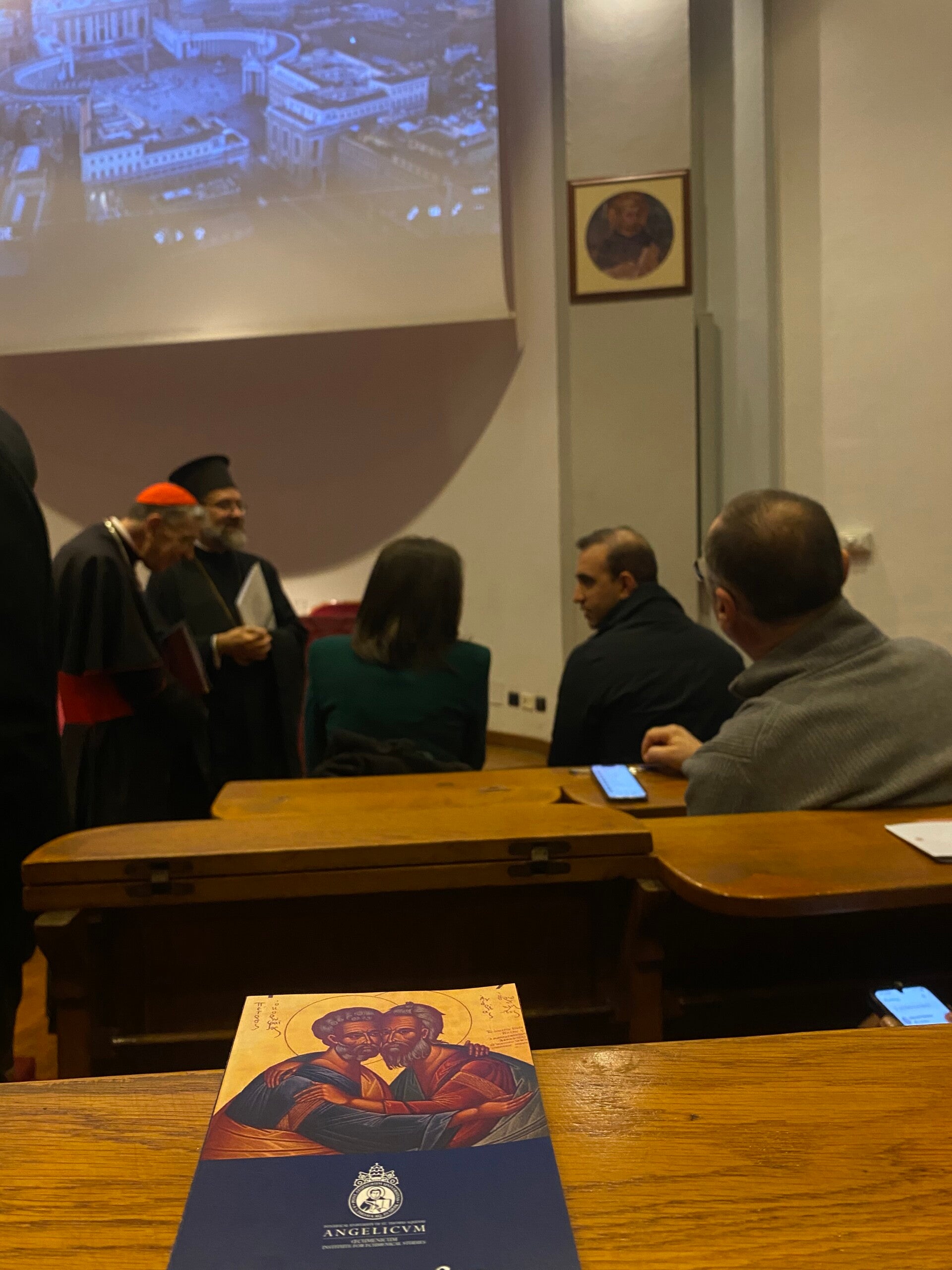
Within the context of the Week of Prayer for Christian Unity in Rome, the Angelicum—Pontifical University of Saint Thomas Aquinas—hosted the conference entitled “60th Anniversary of the Lifting of the Anathemas (1965–2025), Healing of Memories and Christian Unity.”
The event brought together distinguished representatives of the Catholic Church and Eastern Orthodoxy for a historical and theological dialogue on the path toward reconciliation between East and West. The main presentations were delivered by Cardinal Kurt Koch, President of the Pontifical Council for Promoting Christian Unity, and the Ecumenical Patriarchate’s representative Metropolitan Job of Pisidia, who offered complementary perspectives on the historical, ecclesiological, and spiritual dimensions of the ecumenical journey.
- Understanding the Great Schism (1054)
The events commonly referred to as the Great Schism should not be interpreted as an immediate and definitive rupture between the Churches of East and West. Modern historical research shows that the excommunications of 1054 had a limited scope: they were directed at specific individuals rather than entire Churches, and they lacked universal canonical validity. Rather than a sudden break, the schism was one episode within a long process shaped by political, cultural, and ecclesiological tensions.
From a theological perspective, the deepest disagreements were not purely doctrinal but centered on questions of authority and synodality. The growing centralization of Roman authority was perceived in the East as a threat to the legitimate autonomy of local Churches, and many accusations against the West should be understood as defensive responses by Churches seeking to preserve their ecclesial identity.
- Vatican II: Unity in Diversity
The Second Vatican Council marked a decisive turning point. In Unitatis redintegratio, the Catholic Church acknowledged the richness of the Eastern traditions, affirming that their liturgical, spiritual, and canonical heritage is an integral part of the Church’s catholicity. Ecclesial unity ceased to be understood as uniformity and came to be conceived as communion in legitimate diversity.
This shift opened the way for an ecumenism grounded in respect, fraternity, and mutual collaboration, moving unity beyond a merely administrative horizon toward a truly ecclesiological one.
- The Dialogue of Love: Encounter and Reconciliation
One of the conference’s most significant lessons was the central importance of the “dialogue of love,” as Cardinal Kurt Koch explained. Negative emotions from the past cannot be overcome simply through information—however accurate it may be—but through concrete encounters and lived experiences of trust and mutual acceptance.
Since 1965, following the removal of the excommunications of 1054 from ecclesial memory, a tradition of mutual visits between Rome and Constantinople has taken root, as well as official delegations exchanged on major feast days and significant occasions. These gestures are not merely diplomatic; they are ecclesial acts, demonstrating that reconciliation requires theological charity, or an ecclesial agápē, even before full Eucharistic communion is restored.
Cardinal Koch also emphasized the teaching of Benedict XVI (Joseph Ratzinger), who maintained that this dialogue of love is not simply a private matter but has a profound theological depth: it is the restoration of a communion of love between the Churches. Personal and communal encounters thus become signs of the peace of brothers and sisters in Christ, replacing past relationships marked by conflict and estrangement.
- Healing of Memory: Transforming the Past
Metropolitan Job of Pisidia highlighted that reconciliation requires the healing of memory. The past cannot be changed, but it can be transformed in the present through a renewed interpretation that opens the way to forgiveness and reconciliation.
The gesture of 1965, which removed the excommunications of 1054 from official memory, symbolizes the possibility of entrusting the past to God and preparing for a future of communion. As Pope Paul VI expressed to Patriarch Athenagoras:
“To leave the past in God’s hands” allows us to prepare a future that is free and filled with hope.
According to Benedict XVI, the act of “forgetting what lies behind and straining forward to what lies ahead” constitutes a purification of memory, necessary for overcoming historical wounds and tensions—transforming negative memory into a source for encounter and unity.
- Exchange of Gifts: Unity Without Uniformity
Ecumenical dialogue is also understood as an exchange of gifts, in which cultural and liturgical differences are not threats but opportunities to enrich the life of the Church.
Dialogue teaches that no Church is so rich that it does not need to learn from another, nor so poor that it has nothing to offer. Unity is not achieved by imposing norms, but by recognizing the identity of the other and learning mutually. This approach seeks a better balance between synodality and the primacy of the Pope, so that unity may be perceived as service rather than domination.
- An Invitation to Unity: The Relevance of Dialogue Today
Ecumenical dialogue is both a spiritual and practical task: every gesture of fraternity and encounter becomes a sign of hope. Ecumenism does not seek uniformity, but communion in diversity, offering a credible witness to the Gospel.
In this context, Pope Leo XIV revisited a historically sensitive topic: the Filioque. In In Unitate Fidei (23 November 2025), he stated:
“The statement ‘and proceeds from the Father and the Son (Filioque)’ is not found in the text of Constantinople; it was inserted into the Latin Creed by Pope Benedict VIII in 1014 and is a subject of Orthodox-Catholic dialogue.”
This shows that unity is not achieved by hiding differences, but by addressing them with truth and charity—transforming historical conflicts into opportunities for encounter.
Conclusion
The conference at the Angelicum demonstrated that reconciliation between East and West is a gradual process combining history, theology, and spirituality. Christian unity is built through the dialogue of love, the healing of memory, and the exchange of gifts, respecting diversity as an authentic expression of catholicity.
Today, reconciliation is not merely an academic or institutional project, but a prophetic witness: the Church can offer the world an example of how to walk together toward unity—entrusting the past to God and building a reconciled and hope-filled future.


Aggiungi commento
Commenti